



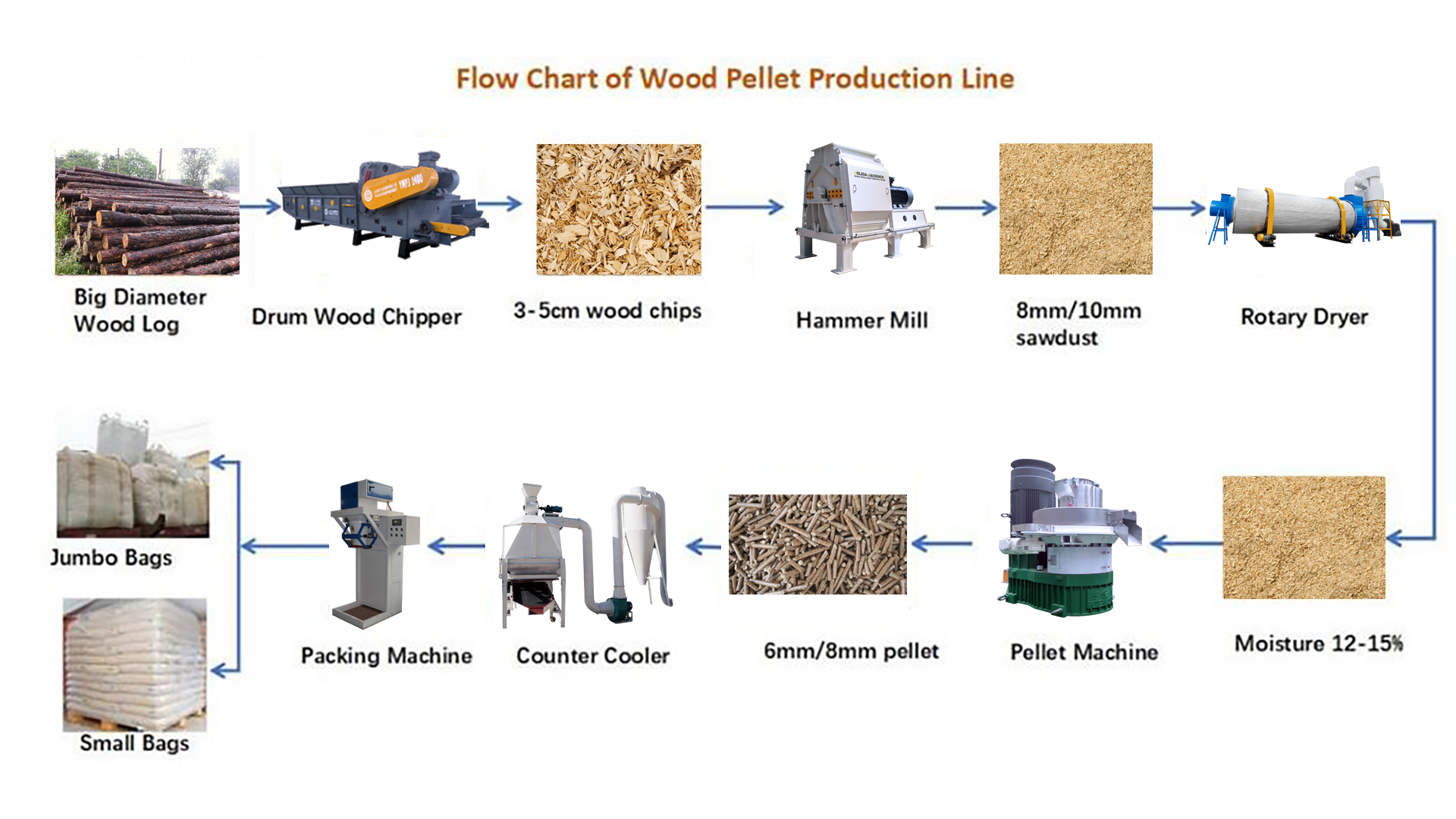
This paper elaborates on the standardized process flow of a commercial biomass pellet production line for recycling wood residues to produce qualified biomass pellets. Each process unit is equipped with specialized processing equipment to support continuous and high-efficiency industrial production. The paper systematically analyzes raw material pretreatment, core pelleting forming, post-treatment finishing, equipment configuration and practical production benefits to fully demonstrate the complete operational system of the production line.
1. Raw Material Pretreatment
Wood residues mainly include tree branches, wood chips, sawdust and wood processing offcuts. All raw materials require unified pretreatment prior to pelleting processing. The pretreatment procedure primarily consists of chipping, pulverization and screening. Bulk wood residues are firstly cut into uniform fragments, then pulverized into fine granular materials. Impurities and oversize particles are removed via vibrating screening equipment to ensure consistent particle fineness of raw materials. The screened qualified materials are then conveyed to the drying system. The optimal moisture content of raw materials is strictly controlled at 8% to 12%, which is the prerequisite for stable pellet forming.
2. Drying and Conveying System
Drying is a critical process for improving the physical properties and finished quality of biomass pellets. Drying equipment is selected according to actual production capacity and initial moisture of raw materials. The following table summarizes mainstream drying equipment and their applicable working conditions:
|
Equipment Type |
Applicable Production Capacity |
Core Characteristics |
|
Single-pass Rotary Dryer |
4-15 t/h |
Low investment cost, simple operation and easy maintenance |
|
Three-pass Rotary Dryer |
3–5 t/h |
High thermal efficiency, strong material adaptability and stable operation |
The dried qualified materials are delivered to buffer silos through fully enclosed conveying equipment. This enclosed conveying structure effectively prevents material leakage and dust overflow, and stabilizes the physical state of raw materials for subsequent processing procedures.
3. Core Pelleting Forming Process
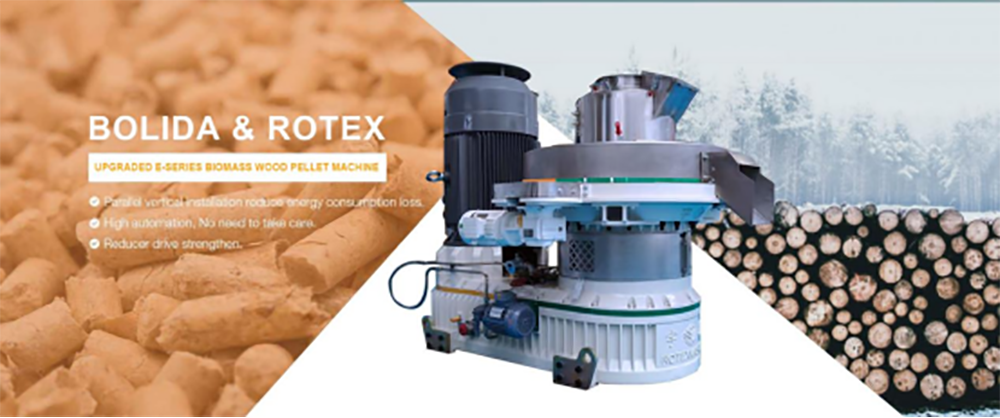
The ring die pellet mill serves as the core processing equipment of the entire production line. Qualified pretreated raw materials are quantitatively fed into the pellet mill and compacted and formed under high pressure and friction temperature. Natural lignin contained in wood materials acts as a natural binder, eliminating the need for any chemical additives. Materials are extruded and molded through ring die holes to form standard cylindrical biomass pellets, realizing continuous cyclic production. Modern high-efficiency pellet mills are equipped with wear-resistant alloy accessories and automatic constant-feeding systems, which effectively reduce equipment failure rate and improve overall production efficiency. This core process directly determines the bulk density, hardness, surface finish and dimensional stability of finished pellets.
4. Post-treatment and Finished Product Handling
Freshly extruded pellets feature high temperature and poor structural stability, which require standardized post-treatment including cooling, screening and packaging. The counter flow cooling dryer steadily reduces pellet temperature and removes residual moisture to prevent pellet cracking and deformation. The vibrating screening machine separates fine powder and unqualified defective pellets, and the recycled fine powder is returned to the production line for secondary processing. Finally, the automatic quantitative packaging unit completes weighing, bagging and sealing of finished products. Standardized finished product packaging facilitates standardized storage, logistics transportation and market sales. The complete post-treatment system significantly upgrades the finished product qualification rate of the production line.
5. Overall Advantages and Conclusion
The integrated biomass pellet production line realizes full automatic processing from raw wood residues to finished biomass pellet products. It possesses the advantages of compact layout, high automation degree and low manpower cost. This recycling production mode not only realizes the resource utilization of waste wood materials, but also produces clean and renewable biomass fuel with broad market prospects and high market demand.
In conclusion, all processing procedures of the pellet production line are closely connected to form an integrated and closed-loop production system. Standardized technological processes and matched professional supporting equipment guarantee the long-term stable and reliable operation of the production line. For production enterprises and investment institutions, this mature and standardized processing solution is a reliable technical scheme for wood residue recycling and clean biomass fuel production.
Name: Christine
Mobile:+86-155 0868 1778
Tel:+86-0531-83658366
Email:info@rotexmaster.com
Add:Zhangqiu City,Shandong Province,China